i dont think you can fully disable the immobiliser. All you can disable is passive immobilisation, where the immobiliser turns itself back on when the car has been sat for X minutes.
In your case, if it was locked with the fob, and that fob is no longer working, you basically have two choices, use the other fob, or use EKA.
Ive had it before where the fob battery cover has turned while the key was in my pocket, disconnecting the battery contacts and clearing the fob sync.
Damn that sounds like a proper unfortunate clusterfk. COVID and Brexit together have really hammered soo many small businesses.
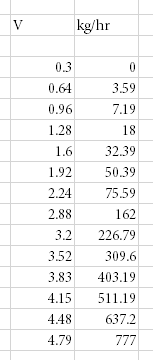
Missing values are 2.5v and 5v
i just could not get the nanocom to capture the 2.5v point. I might reconfigure the DAC to output a constant 2.5v and see if that will give me a reading. I did get multiple readings for the 5v point, but it displayed 788kg/hr, which doesnt fit the curve at all. I suspect they've set full scale around 4.8v and anything beyond that is probably used to indicate a fault. In any case, 777kg/hr is around 270hp worth of airflow, so i dont think it'll ever be going beyond there in normal operation.

Had another go last night, and it was a frustrating hour fighting with the Nanocom. Seriously unimpressed with that POS tbh.
It refused to stay connected to the ECU when displaying the "AIR - IDLE" tab. you'd get 20-30 seconds at most before it would just stop updating. To get it to reconnect, you had to exit all the way out to the main screen and go all the way back in again. and every time you did that, nanocom stops logging. In the end i just used my phone camera to record the screen, and manually plucked the values out later by rewatching the videos later while sat in front of the computer. Ofcourse each time you start logging its in a random place in the sequence, so you need to do it multiple times to actually see all the figures.
Managed 14 of the 16 data points which when plotted in excel makes a fairly nice looking curve.
I then used the "trendline" function to plot a line and used the resulting equation to produce 256 data points from the curve. its not 100%, but its very close and i'm sure its good enough for an old V8! So we're getting somewhere. I'll post some of the data in a little while.
Bought some black leather door cards. Ofcourse the clever-sod that removed them has managed to break the drivers card. It'll probably be alright, but certainly is a bit annoying after finally finding a set.
Also bought a late spec cupholder and removed some more bits of trim to vinyl wrap.
I'll need to take some photos and get a wee thread going.
I remember using these guys years ago, always seemed decent, and tbh i hadnt actually realised they'd gone under. Anyone know the gist?
while it incorrectly says RHD, i'm pretty certain my 94 is laid out the same at the rear.
The flexi pipes come off the centre of the axle and go up to the left/passenger side, then the hardlines loop back around, run across the car and go up the drivers chassis leg.
Its been ages since i've been under it, but i do vaguely recall seeing the pipework and thinking "ah those are in the way of the second exhaust box/pipework". But it was a long time ago. Now i'm thinking about it, i also recall the someones fitted a later model axle without the proper bracket for the brake pipes, and the old bracket was jubilee clipped in place. I had intended to revisit that and probably switch over to the later style setup and repipe everything with new flexis. And i've instead ignored it for 5 years 😮
My remote doesnt work due to reasons i've never quite figured out. Plus, i only have one, with the wifes keychain only having a standard key blade on it.
As such i always lock with the key. As far as i can tell, it all works as normal. At one point i had a bad microswitch, so the car occasionally didnt "see" the unlock event from the key, If you noticed and unlocked again, it usually worked, but if you didnt notice and opened the door and tried to start the car, the alarm would go off and the car displays engine immobilised as you would expect.
My car is a very early model so i dont know if that makes a difference. I've noticed in Nanocom it says "Security Learn: NO" so i'm not sure if my car acts differently to any others. It definitely doesnt have passive immobilisation. I often leave it unlocked and it'll always start immediately without any key button pressing.
All i've figured out is that if you always use the key, it works fine, if you try and mix them, you run into issues. Specifically locking with the fob, means you cant then unlock with the key.
I've been contemplating fitting some sort of aftermarket fob system, but for now it works well enough with the key so its been ignored.
@jacckk - Thanks i'll take a look at that, is that why Nanocom shows "adaptive airflow -0.6"?
Clive, this was my initial thought. However to do that you need a known working (correctly!) MAF, and those dont exist ;) If they did then i wouldnt be doing all of this :(
All youd achieve otherwise, is perfectly replicating your faulty worn out 20AM thats not working properly!
yeah exactly, i'm hoping that either i can get a nice "curve fit" trendline that works with my 16 data points and extrapolate there, or i'll do some more passes with a tighter interval. Probably a bit of both. If the Nanocom will stay connected i can just get the arduino to cycle thru with a very small step size and log the whole series.
The bosch maf table is 512 entries long, so thats a voltage step of a bit less than 0.01v between each entry. I'm not sure how good the Arduino ADC is, but i guess if we can build a translation table thats at least 256 entries we should be pretty close, ideally we can do some interpolation between lookups too.
The wonky IAT is apparently quite common on GEMS cars, i've not looked into it too closely, but i will try to measure and take some readings there too.
The MAF should self compensate for all those things like you say, its measuring mass, not volume, i would hazard that the newer Bosch units are probably doing a better job than the 20AM though.
The lag between the kg/h and volts is definitely a nanocom issue (or perhaps just the ECU's diagnostic interface/protocol) and yeah, i would expect the ECU to act instantly to changes in MAF voltage. As for everything else, i really dont know. The DAC i'm using can apparently perform updates at around 6khz, which i would hope is plenty fast enough
That's good to know. I wonder where the "doesn't fit" comments came from. These things usually have some fig of truth to them even if they aren't totally accurate.
Maybe it's just the mounts are missing on an earlier car or something.
mad-as wrote:
silly question
even if it only read close to the parameters, (thats a differant MAF) wouldn't the computer trim it in or just not read it .
The long term trim is a single multiplier applied to the whole curve. If the whole curve was somehow scaled, then the trim would work.
The curve however is not linear. Voltage changes much faster at low airflows, and much slower at high airflows. Which means if the curve ends up the wrong shape the ECU simply cannot trim it out.
Once I get some more data points I'll throw up a graph showing how different the curves can be.
I've decided to create this thread to document my efforts at creating a replacement for the GEMS MAF. As some of you will know, the GEMS MAF is unavailable anywhere other than landrover (if its even still available) and costs a fortune. Aftermarket units are junk. After buying probably 4 or 5 used MAFs at this point, i wanted to find a solution.
My thinking is simple. If we can figure out the curve, we can build a "module" which can translate the values from some other cars MAF, over to signals the GEMS ECU expects.
Having had some background in tinkering with 2000's VAG cars, i know that their Motronic 7.5 ECU's contain a 512x1 table which contains the MAF calibration in a very simple format: kg/sec against voltage. As such i have curves available for many common VAG MAFs. Those VAG MAF's are ubiquitous, readily available, and cheap new. I also already have a few units knocking around i can use for testing. Half the problem is thus "sorted"
If we can acquire the same curve for the Lucas 20AM, we can then create a translation table between the two.
Trying to find this information online seems pretty much impossible. Tuning info on the GEMS is rare, and i havent been able to find the factory calibration anywhere. However when replacing my broken MAF with yet another used one recently i noticed something potentially useful. RAVE provides airflow figures that should be seen at various engine speeds. One reason i know my newest-old MAF is junk is that it massively overreads against these figures. However while staring at the Nanocom, i realised it was showing both airflow in kg/sec and MAF voltage...
My first attempt then was to drive around, and use the nanocom logging function to log these two values. Unfortunately nanocom updates extremely slowly and seems to only pull one value at a time, which means the displayed airflow and voltage dont line up in time, and thus its all a bit random. Perhaps with many miles of logged data, we could get something resembling a curve, but i wasnt happy with this approach at all.
Spent some time thinking about it, and threw together a MAF "stimulator". Essentially its an Arduino Nano, and a MCP4725 DAC. The arduino is programmed step from 0v to 5v in 0.3125v intervals. Fishing about in my box of parts i found a matching connector for the harness MAF plug, so i can plug this contraption in, inplace of the MAF. The idea being that instead of driving around, i can just sit on the drive, ignition on, engine off, and feed in the sequence of voltages and log the output.

So, tonight, i went to give it a try. And, provisional results are that it worked, kinda! Nanocom kept disconnecting, and i realised the battery was flat, which potentially was causing the nanocom weirdness, however i managed to capture a bit of data before i gave up with the battery down to 7 volts and went and fished out the battery charger instead.
Interestingly you can see the lag i was talking about in the log due to how the nanocom polls each value. In order to try and minimise this, i'd set the Arduino to step the voltage once every 10 seconds. It appears to update the voltage first, then airflow shortly after.
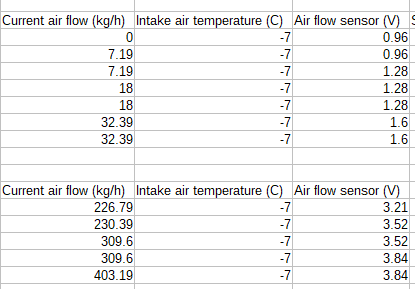
As you can see it was a struggle to keep the thing connected for more than about 30seconds, but you can also see some nice clear data points. Will revisit later in the week when it has a charged battery and see if we can capture the full sweep.
Early cars have two brake pipes in the middle of the axle that loop up to a bracket in the middle of the floor.
Later cars moved the pipes out onto the body and dropped into the axle from the wheel arch instead.
I think the "T" section of the later exhaust would conflict with the brake pipes on an early car.
romanrob wrote:
I've had a lone Hurricane alloy on eBay for 1yr+, dont hold ur breath, not sure what the demand is these days
ebays hit and miss, but i do sell a fair bit on there from cars i've dismantled. It boils down to price and postage.
If your only offering collection, you instantly shrink your audience to a tiny fraction of what it was. As a result you then need to either wait for a long time for someone willing and local. Or you make it cheap enough that someones willing to travel for it.
Taking a quick look, several single Hurricane wheels have sold in the last month or two alone, so there is clearly some demand, suggesting that there was something "wrong" with your listing.
An auction with a high starting price isnt a great move, IMO. I tend to go one of two ways. If something is in fairly high demand, and i know it'll get bid up, i will list it as an auction for a 99p starting price. Gets folks in the door and interested, and so long as you've got a couple of interested parties bidding its going to sell for what its worth.
If somethings likely to be in low demand, ie where a 99p auctions going to end up with 1 bid, i will instead use a buy it now listing with offers enabled.
Also, do your research thru completed listings and figure out what your item is actually selling for. Theres no point listing it for £300 collection only if everyone else is selling them for £200 with free shipping.
In this case, theres also the unfortunate combination of good tyres, which should add value, but they are winters, and its May!
On the petrol models there are actually two brake switches. The brake bulb output from the normal brake switch is connected to the cruise ECU, then the brake vent valve also has an additional switch which is also connected to the cruise ECU. Then the vent valve itself acts as a redundancy mechanism to dump the vacuum.
For petrols theres a very good diagnostic guide in rave, which steps you thru checking all the sensors and things. Might be worth looking to see if the same exists for the diesel version.
on the factory P38 setup, the midbox does most of the work, so i could quite believe it will be fine with just straight piped backboxes.
On an aftermarket system, they may or may not have quite matched the complexity of the factory midbox. Mine for instance uses a "straight thru" style middle box, which certainly doesn't take as much of the noise out as the factory box did.
usually with aftermarket/"tuner" systems they inject a water methanol mixture, not just plain water, so the methanol has combustive properties. Its mostly about charge cooling and reducing detonation though, which means as above, you can run more boost or more aggressive timing. Doubt it would do much on NA motor.
Even the spitfire application was using it on a supercharged engine. In aircraft, turbo/supercharging is normally used to offset lower atmospheric pressures at higher altitudes. In the spitfire, they rejigged this a little to allow the charger to provide additional boost at lower altitudes when it had "spare" capacity. The water/methanol was thus used to reduce detonation risk in those conditions.
can you get a quote from a local exhaust fabricator?
On mine, it came with typical rotted out aftermarket boxes. First thing to go was the rear box. I happened to find a stainless rear pipe on ebay, but it didnt have a silencer, was just pipe. I sectioned the end of it and let in an OEM (stainless) box which came from my brothers E90 BMW he'd broken for spares. Luckily mine is the single pipe system, so half the effort to replace!
Some months later the middle box disintegrated. I took it to a local exhaust fabricator, who cut back and replaced the end of the Y pipe (it had rotted thru at the flange), added a V band, and then a big stainless silencer, and mated it all up to my existing rear pipe and i think it cost around £300.
overheating will thin the oil out, which may in turn cause a loss of oil pressure if the pump cannot pump enough displacement to keep up with the thin oil. Thats ofcourse very engine specific, some engines have loads of oil pump headroom, and others have none.
I had a high mileage 1.8T in my first A4 where the oil pump was pretty worn out, and had an oil pressure guage fitted. Under normal driving it was fine, but if stuck in traffic with the coolant temp up nearer 100c than 90c, instead of the normal 15psi or so at idle it would drop down into the 7-8psi range, and the lifters would start depressurising and ticking. Lifting the engine RPM would get the pressure back up, but would also mean the engine ran hotter, creating a bit of a feedback loop. Was always a bit nervewracking stuck in traffic with that engine.
I've also heard of engines seizing due to overheating, presumably due to thermal expansion closing up running clearances.